
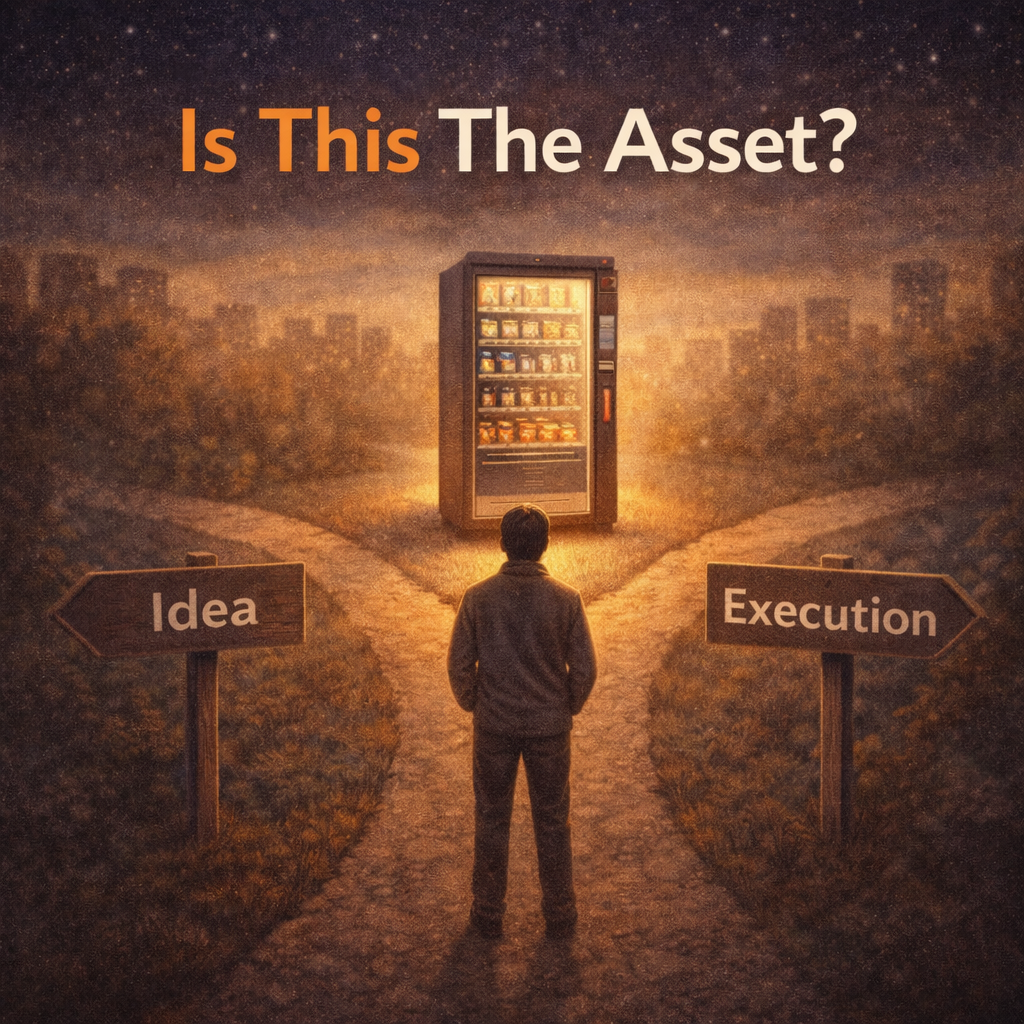
One of the core goals of my Zero to Hero project is to build equity assets.
These are things you invest in once that generate money over time with little or moderate ongoing effort. Instead of something that costs money every month, it becomes something that produces money every month.
That concept has been driving a lot of my thinking lately.
I’ve explored several different ideas so far. Digital assets are one of them. Things like eBooks or digital products that you can create once and sell repeatedly on platforms like ClickBank or Etsy. Those are attractive because they can scale without physical effort.
But one asset keeps coming back into my mind over and over again.
Vending machines.
Specifically, I’ve been looking at the newer smart AI vending machines that are becoming more common.
The Idea That Won’t Leave My Head
What’s interesting is how the idea starts to take over your thinking.
Now when I walk around town, I’m constantly noticing locations. I’ll see a place with a lot of foot traffic and immediately think, that location could support a vending machine.
I even notice places near my own workplace that have decent traffic but no vending options at all.
So the wheels are definitely turning.
But the challenge I keep running into isn’t the machine cost. It’s not the inventory cost either.
It’s time.
The Lone Wolf Problem
A lot of vending machine operators talk about something called the “lone wolf problem.”
The lone wolf is the person who says:
- I’ll find the locations
- I’ll buy the machines
- I’ll source the products
- I’ll stock the machines
- I’ll collect the money
- I’ll manage the entire operation
In theory, that sounds efficient.
In reality, it becomes a bottleneck.
The real value in a vending machine business isn’t stocking machines. The real value is finding new locations. Building relationships. Expanding the network.
If you’re constantly restocking machines, you’re not growing the business.
And that’s where the concern comes in.
The Time Constraint
I already have a full-time job.
I already run another business that requires attention.
The last thing I want to do is start something that pulls time away from the things already working.
So I keep asking myself the same question:
Is this something that adds leverage to my life, or adds complexity?
Because those are two very different outcomes.
Splitting the Difference
One idea I’ve been considering is starting small.
Instead of trying to build a full vending machine business from day one, what if we simply tested the concept?
For example:
- Start with 3–4 machines locally
- My partner and I split the restocking responsibilities
- No employees
- No warehouse
- Just a small, controlled test
If those machines performed well, then we’d have real data. At that point we could decide whether expanding makes sense.
This approach would limit the time commitment while still letting us see if the model works.
But even that comes with a catch.
The Catch-22
The problem with vending machines is that doing it properly usually requires doing it at scale.
To build a real vending operation you often need:
- Multiple machines
- Reliable staff
- Inventory management
- Storage space
- A process for servicing locations
And that means investing money, time, and structure from the start.
That’s the part that makes me hesitate.
Because what I don’t want to do is commit resources into something only to realize later that the return wasn’t worth the effort.
The Instagram Illusion
If you scroll through social media, vending machines look ridiculously easy.
Buy a machine.
Drop it somewhere.
Make $100,000 a month.
Reality is never that simple.
Every business has friction. Every business has logistics. Every business requires time somewhere in the system.
I don’t want this blog to pretend otherwise.
The Value of Thinking It Through
Part of this post is simply me documenting the thinking process.
When you see someone succeeding at something, you usually only see the finished result. You rarely see the hours of thinking, researching, questioning, and second-guessing that happen before the first move.
I go through the same thing everyone else does:
- Analysis paralysis
- Overthinking
- Underthinking
- Changing directions
Before I started eBay reselling again this year, I went through the exact same mental process. I watched videos, researched strategies, imagined how it would work, and ran the scenarios in my head.
Eventually I had to stop thinking and just start doing.
The Real Lesson
Right now, vending machines are still in the thinking phase.
I’m running the process in my head.
What would it look like with three machines?
How long would restocking take?
Where would I source product?
How would I approach potential locations?
I’m mentally simulating the business.
Sometimes that process leads to action.
Sometimes it leads to abandoning the idea entirely.
Both outcomes are valuable.
Because the real goal of Zero to Hero isn’t just to chase opportunities.
It’s to carefully choose the ones worth pursuing.
And sometimes the most important step isn’t action.
It’s thinking clearly first.