
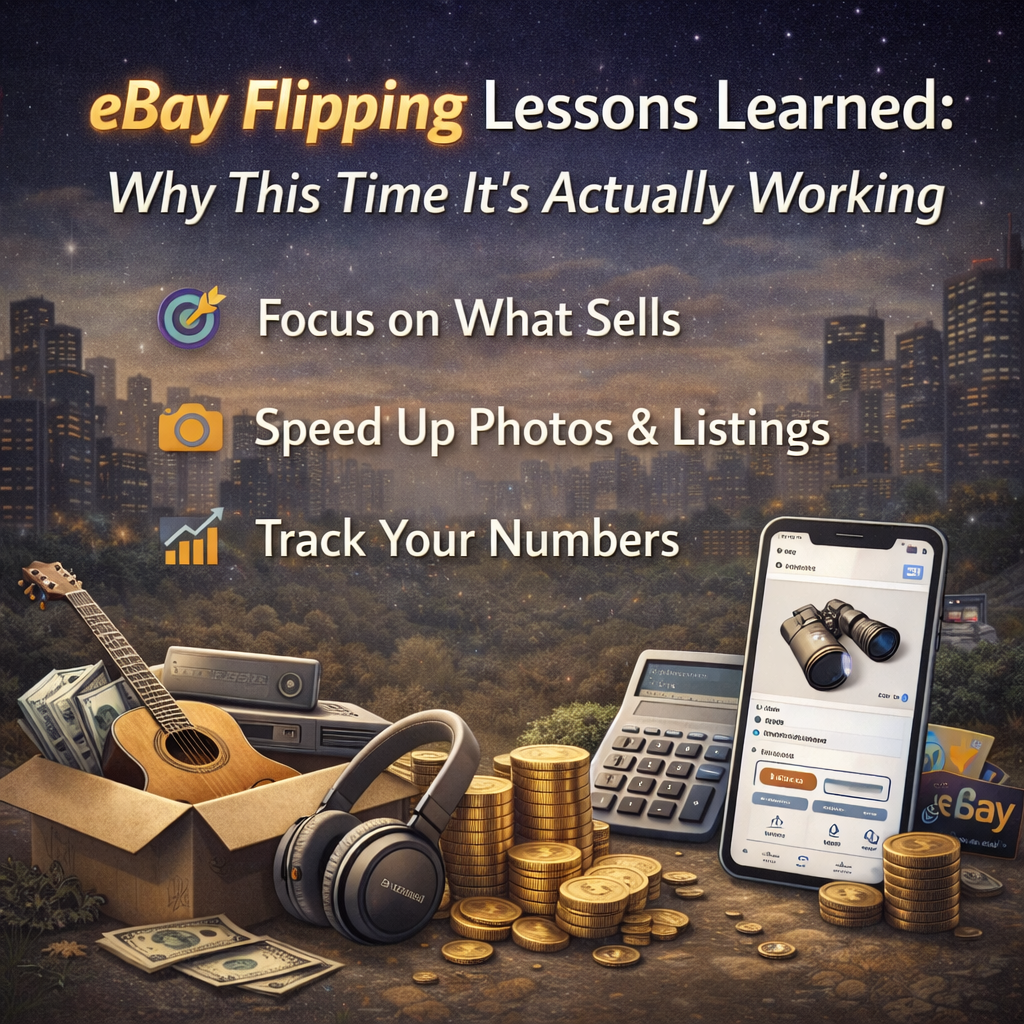
This is not my first time flipping items on eBay. In fact, it’s probably my third or fourth serious attempt over the years. But this run is different. It’s the most successful I’ve ever been, and when I look back at how I used to flip compared to how I do it now, the differences are significant. The strategy, the tools, and the mindset have all changed, and that’s why this time it’s working.
In the past, most of my flipping revolved around arbitrage. I would search eBay itself for undervalued items, buy them, and immediately relist them at a higher price. Sometimes it worked. Sometimes it didn’t. It was inconsistent, competitive, and often came down to timing and luck. On top of that, the technology simply wasn’t there yet. Photos required a digital camera, editing was slow, and every listing description had to be written manually. The entire process was friction-heavy.
Sourcing opportunities have also changed dramatically. In my area, there are far more thrift stores than there were years ago. Places like Goodwill are everywhere now, which creates constant opportunities to find inventory. At the same time, competition is higher, and stores like Goodwill are much better at understanding market value. They often price items at roughly half of what they believe it could resell for. Occasionally, something slips through the cracks and gets priced far too low. Those are the wins worth waiting for.
One of the biggest changes this time around is that I no longer do eBay-to-eBay arbitrage. I am not buying items on eBay and trying to relist them. Where I do allow some arbitrage is on Facebook Marketplace and Craigslist. Even there, it requires speed, discipline, and selectivity. The good deals disappear fast. You have to know your products, know your margins, and be willing to walk away if the numbers don’t make sense.
Where I’ve had the most consistent success sourcing inventory is Goodwill. The key lesson here is to stop buying junk. Just because something is cheap does not mean it’s worth flipping. A $7 item you can sell for $14 is rarely worth the time, effort, and fees. But a $4 item that can sell for $40 absolutely is. The difference is focus. I stick to categories where I understand value. Electronics, musical gear, hard goods, and certain bags have been strong for me. Clothing is tempting, but I’m not good at it yet. Instead of forcing it, I’m slowly experimenting while staying in my comfort zone.
Technology is a massive advantage now. Tools like SellRays, Flipper, Google Lens, and eBay’s sold listings make pricing far less of a guessing game. You can check comps in real time while standing in the store. The downside is that everyone else can too, which makes discipline even more important. Knowing what to skip is just as valuable as knowing what to buy.
Time has become one of my most important metrics. I used to overthink photos and listings. Now I optimize for speed. I take 10 to 15 photos per item using my phone. I have a simple lighting setup and a basic backdrop made from a sheet or pillowcase. I edit directly inside eBay, usually just cropping and adjusting brightness if needed. The entire photo process takes a couple of minutes per item.
AI has completely changed listing creation. I paste my photos into ChatGPT and ask it to generate a listing title, description, and pricing. The pricing is often optimistic, so I adjust it based on sold comps, but the descriptions are strong and the titles are usually SEO-friendly. This alone saves a massive amount of time and removes one of the biggest mental barriers to listing consistently.
Consistency is another major difference this time. In the past, I would source a bunch of items, list them all at once, then do nothing for days. Now I keep a running box of inventory. Items from Goodwill, my house, Craigslist, or Facebook Marketplace all go into that box. Every day, I aim to list two to five items and schedule them so eBay sees at least one new listing daily. I have not missed a day of listing during this run, and I currently have items scheduled out nearly two weeks in advance. That steady cadence has been a game changer.
Finally, knowing my numbers has been critical. In the past, I tracked everything loosely in spreadsheets and often underestimated expenses. Shipping, fees, mileage, supplies, and time all add up. This time, I use Flipwise to track everything. It pulls eBay data automatically, tracks sourcing dates, days listed, fees, shipping costs, and expenses. I log mileage, storage supplies, cleaning tools, and even the monthly cost of the app itself.
The result is clarity. I know exactly what I gross and what I net each month. That net number is what matters, because it feeds directly into the Growth Fund I wrote about previously. Seeing real profits, not fuzzy estimates, keeps me motivated and disciplined.
If you’re thinking about getting into flipping, my biggest takeaway is this: strategy matters more than effort. Focus on what you know. Move fast but be selective. Use modern tools. Stay consistent. And track your numbers honestly. This approach is working for me, and I believe it can work for others willing to treat flipping like a system instead of a hustle.